MATHHX B

MATHHX B

\(\newcommand{\footnotename}{footnote}\) \(\def \LWRfootnote {1}\) \(\newcommand {\footnote }[2][\LWRfootnote ]{{}^{\mathrm {#1}}}\) \(\newcommand {\footnotemark }[1][\LWRfootnote ]{{}^{\mathrm {#1}}}\) \(\let \LWRorighspace \hspace \) \(\renewcommand {\hspace }{\ifstar \LWRorighspace \LWRorighspace }\) \(\newcommand {\TextOrMath }[2]{#2}\) \(\newcommand {\mathnormal }[1]{{#1}}\) \(\newcommand \ensuremath [1]{#1}\) \(\newcommand {\LWRframebox }[2][]{\fbox {#2}} \newcommand {\framebox }[1][]{\LWRframebox } \) \(\newcommand {\setlength }[2]{}\) \(\newcommand {\addtolength }[2]{}\) \(\newcommand {\setcounter }[2]{}\) \(\newcommand {\addtocounter }[2]{}\) \(\newcommand {\arabic }[1]{}\) \(\newcommand {\number }[1]{}\) \(\newcommand {\noalign }[1]{\text {#1}\notag \\}\) \(\newcommand {\cline }[1]{}\) \(\newcommand {\directlua }[1]{\text {(directlua)}}\) \(\newcommand {\luatexdirectlua }[1]{\text {(directlua)}}\) \(\newcommand {\protect }{}\) \(\def \LWRabsorbnumber #1 {}\) \(\def \LWRabsorbquotenumber "#1 {}\) \(\newcommand {\LWRabsorboption }[1][]{}\) \(\newcommand {\LWRabsorbtwooptions }[1][]{\LWRabsorboption }\) \(\def \mathchar {\ifnextchar "\LWRabsorbquotenumber \LWRabsorbnumber }\) \(\def \mathcode #1={\mathchar }\) \(\let \delcode \mathcode \) \(\let \delimiter \mathchar \) \(\def \oe {\unicode {x0153}}\) \(\def \OE {\unicode {x0152}}\) \(\def \ae {\unicode {x00E6}}\) \(\def \AE {\unicode {x00C6}}\) \(\def \aa {\unicode {x00E5}}\) \(\def \AA {\unicode {x00C5}}\) \(\def \o {\unicode {x00F8}}\) \(\def \O {\unicode {x00D8}}\) \(\def \l {\unicode {x0142}}\) \(\def \L {\unicode {x0141}}\) \(\def \ss {\unicode {x00DF}}\) \(\def \SS {\unicode {x1E9E}}\) \(\def \dag {\unicode {x2020}}\) \(\def \ddag {\unicode {x2021}}\) \(\def \P {\unicode {x00B6}}\) \(\def \copyright {\unicode {x00A9}}\) \(\def \pounds {\unicode {x00A3}}\) \(\let \LWRref \ref \) \(\renewcommand {\ref }{\ifstar \LWRref \LWRref }\) \( \newcommand {\multicolumn }[3]{#3}\) \(\require {textcomp}\) \(\require {colortbl}\) \(\let \LWRorigcolumncolor \columncolor \) \(\renewcommand {\columncolor }[2][named]{\LWRorigcolumncolor [#1]{#2}\LWRabsorbtwooptions }\) \(\let \LWRorigrowcolor \rowcolor \) \(\renewcommand {\rowcolor }[2][named]{\LWRorigrowcolor [#1]{#2}\LWRabsorbtwooptions }\) \(\let \LWRorigcellcolor \cellcolor \) \(\renewcommand {\cellcolor }[2][named]{\LWRorigcellcolor [#1]{#2}\LWRabsorbtwooptions }\) \(\newcommand {\tothe }[1]{^{#1}}\) \(\newcommand {\raiseto }[2]{{#2}^{#1}}\) \(\newcommand {\LWRsiunitxEND }{}\) \(\def \LWRsiunitxang #1;#2;#3;#4\LWRsiunitxEND {\ifblank {#1}{}{\num {#1}\degree }\ifblank {#2}{}{\num {#2}^{\unicode {x2032}}}\ifblank {#3}{}{\num {#3}^{\unicode {x2033}}}}\) \(\newcommand {\ang }[2][]{\LWRsiunitxang #2;;;\LWRsiunitxEND }\) \(\def \LWRsiunitxdistribunit {}\) \(\newcommand {\LWRsiunitxENDTWO }{}\) \(\def \LWRsiunitxprintdecimalsubtwo #1,#2,#3\LWRsiunitxENDTWO {\ifblank {#1}{0}{\mathrm {#1}}\ifblank {#2}{}{{\LWRsiunitxdecimal }\mathrm {#2}}}\) \(\def \LWRsiunitxprintdecimalsub #1.#2.#3\LWRsiunitxEND {\LWRsiunitxprintdecimalsubtwo #1,,\LWRsiunitxENDTWO \ifblank {#2}{}{{\LWRsiunitxdecimal }\LWRsiunitxprintdecimalsubtwo #2,,\LWRsiunitxENDTWO }}\) \(\newcommand {\LWRsiunitxprintdecimal }[1]{\LWRsiunitxprintdecimalsub #1...\LWRsiunitxEND }\) \(\def \LWRsiunitxnumplus #1+#2+#3\LWRsiunitxEND {\ifblank {#2}{\LWRsiunitxprintdecimal {#1}}{\ifblank {#1}{\LWRsiunitxprintdecimal {#2}}{\LWRsiunitxprintdecimal {#1}\unicode {x02B}\LWRsiunitxprintdecimal {#2}}}\LWRsiunitxdistribunit }\) \(\def \LWRsiunitxnumminus #1-#2-#3\LWRsiunitxEND {\ifblank {#2}{\LWRsiunitxnumplus #1+++\LWRsiunitxEND }{\ifblank {#1}{}{\LWRsiunitxprintdecimal {#1}}\unicode {x02212}\LWRsiunitxprintdecimal {#2}\LWRsiunitxdistribunit }}\) \(\def \LWRsiunitxnumpmmacro #1\pm #2\pm #3\LWRsiunitxEND {\ifblank {#2}{\LWRsiunitxnumminus #1---\LWRsiunitxEND }{\LWRsiunitxprintdecimal {#1}\unicode {x0B1}\LWRsiunitxprintdecimal {#2}\LWRsiunitxdistribunit }}\) \(\def \LWRsiunitxnumpm #1+-#2+-#3\LWRsiunitxEND {\ifblank {#2}{\LWRsiunitxnumpmmacro #1\pm \pm \pm \LWRsiunitxEND }{\LWRsiunitxprintdecimal {#1}\unicode {x0B1}\LWRsiunitxprintdecimal {#2}\LWRsiunitxdistribunit }}\) \(\newcommand {\LWRsiunitxnumscientific }[2]{\ifblank {#1}{}{\ifstrequal {#1}{-}{-}{\LWRsiunitxprintdecimal {#1}\times }}10^{\LWRsiunitxprintdecimal {#2}}\LWRsiunitxdistribunit }\) \(\def \LWRsiunitxnumD #1D#2D#3\LWRsiunitxEND {\ifblank {#2}{\LWRsiunitxnumpm #1+-+-\LWRsiunitxEND }{\mathrm {\LWRsiunitxnumscientific {#1}{#2}}}}\) \(\def \LWRsiunitxnumd #1d#2d#3\LWRsiunitxEND {\ifblank {#2}{\LWRsiunitxnumD #1DDD\LWRsiunitxEND }{\mathrm {\LWRsiunitxnumscientific {#1}{#2}}}}\) \(\def \LWRsiunitxnumE #1E#2E#3\LWRsiunitxEND {\ifblank {#2}{\LWRsiunitxnumd #1ddd\LWRsiunitxEND }{\mathrm {\LWRsiunitxnumscientific {#1}{#2}}}}\) \(\def \LWRsiunitxnume #1e#2e#3\LWRsiunitxEND {\ifblank {#2}{\LWRsiunitxnumE #1EEE\LWRsiunitxEND }{\mathrm {\LWRsiunitxnumscientific {#1}{#2}}}}\) \(\def \LWRsiunitxnumx #1x#2x#3x#4\LWRsiunitxEND {\ifblank {#2}{\LWRsiunitxnume #1eee\LWRsiunitxEND }{\ifblank {#3}{\LWRsiunitxnume #1eee\LWRsiunitxEND \times \LWRsiunitxnume #2eee\LWRsiunitxEND }{\LWRsiunitxnume #1eee\LWRsiunitxEND \times \LWRsiunitxnume #2eee\LWRsiunitxEND \times \LWRsiunitxnume #3eee\LWRsiunitxEND }}}\) \(\newcommand {\num }[2][]{\LWRsiunitxnumx #2xxxxx\LWRsiunitxEND }\) \(\newcommand {\si }[2][]{\mathrm {\gsubstitute {#2}{~}{\,}}}\) \(\def \LWRsiunitxSIopt #1[#2]#3{\def \LWRsiunitxdistribunit {\,\si {#3}}{#2}\num {#1}\def \LWRsiunitxdistribunit {}}\) \(\newcommand {\LWRsiunitxSI }[2]{\def \LWRsiunitxdistribunit {\,\si {#2}}\num {#1}\def \LWRsiunitxdistribunit {}}\) \(\newcommand {\SI }[2][]{\ifnextchar [{\LWRsiunitxSIopt {#2}}{\LWRsiunitxSI {#2}}}\) \(\newcommand {\numlist }[2][]{\text {#2}}\) \(\newcommand {\numrange }[3][]{\num {#2}\ \LWRsiunitxrangephrase \ \num {#3}}\) \(\newcommand {\SIlist }[3][]{\text {#2}\,\si {#3}}\) \(\newcommand {\SIrange }[4][]{\num {#2}\,#4\ \LWRsiunitxrangephrase \ \num {#3}\,#4}\) \(\newcommand {\tablenum }[2][]{\mathrm {#2}}\) \(\newcommand {\ampere }{\mathrm {A}}\) \(\newcommand {\candela }{\mathrm {cd}}\) \(\newcommand {\kelvin }{\mathrm {K}}\) \(\newcommand {\kilogram }{\mathrm {kg}}\) \(\newcommand {\metre }{\mathrm {m}}\) \(\newcommand {\mole }{\mathrm {mol}}\) \(\newcommand {\second }{\mathrm {s}}\) \(\newcommand {\becquerel }{\mathrm {Bq}}\) \(\newcommand {\degreeCelsius }{\unicode {x2103}}\) \(\newcommand {\coulomb }{\mathrm {C}}\) \(\newcommand {\farad }{\mathrm {F}}\) \(\newcommand {\gray }{\mathrm {Gy}}\) \(\newcommand {\hertz }{\mathrm {Hz}}\) \(\newcommand {\henry }{\mathrm {H}}\) \(\newcommand {\joule }{\mathrm {J}}\) \(\newcommand {\katal }{\mathrm {kat}}\) \(\newcommand {\lumen }{\mathrm {lm}}\) \(\newcommand {\lux }{\mathrm {lx}}\) \(\newcommand {\newton }{\mathrm {N}}\) \(\newcommand {\ohm }{\mathrm {\Omega }}\) \(\newcommand {\pascal }{\mathrm {Pa}}\) \(\newcommand {\radian }{\mathrm {rad}}\) \(\newcommand {\siemens }{\mathrm {S}}\) \(\newcommand {\sievert }{\mathrm {Sv}}\) \(\newcommand {\steradian }{\mathrm {sr}}\) \(\newcommand {\tesla }{\mathrm {T}}\) \(\newcommand {\volt }{\mathrm {V}}\) \(\newcommand {\watt }{\mathrm {W}}\) \(\newcommand {\weber }{\mathrm {Wb}}\) \(\newcommand {\day }{\mathrm {d}}\) \(\newcommand {\degree }{\mathrm {^\circ }}\) \(\newcommand {\hectare }{\mathrm {ha}}\) \(\newcommand {\hour }{\mathrm {h}}\) \(\newcommand {\litre }{\mathrm {l}}\) \(\newcommand {\liter }{\mathrm {L}}\) \(\newcommand {\arcminute }{^\prime }\) \(\newcommand {\minute }{\mathrm {min}}\) \(\newcommand {\arcsecond }{^{\prime \prime }}\) \(\newcommand {\tonne }{\mathrm {t}}\) \(\newcommand {\astronomicalunit }{au}\) \(\newcommand {\atomicmassunit }{u}\) \(\newcommand {\bohr }{\mathit {a}_0}\) \(\newcommand {\clight }{\mathit {c}_0}\) \(\newcommand {\dalton }{\mathrm {D}_\mathrm {a}}\) \(\newcommand {\electronmass }{\mathit {m}_{\mathrm {e}}}\) \(\newcommand {\electronvolt }{\mathrm {eV}}\) \(\newcommand {\elementarycharge }{\mathit {e}}\) \(\newcommand {\hartree }{\mathit {E}_{\mathrm {h}}}\) \(\newcommand {\planckbar }{\mathit {\unicode {x210F}}}\) \(\newcommand {\angstrom }{\mathrm {\unicode {x212B}}}\) \(\let \LWRorigbar \bar \) \(\newcommand {\barn }{\mathrm {b}}\) \(\newcommand {\bel }{\mathrm {B}}\) \(\newcommand {\decibel }{\mathrm {dB}}\) \(\newcommand {\knot }{\mathrm {kn}}\) \(\newcommand {\mmHg }{\mathrm {mmHg}}\) \(\newcommand {\nauticalmile }{\mathrm {M}}\) \(\newcommand {\neper }{\mathrm {Np}}\) \(\newcommand {\yocto }{\mathrm {y}}\) \(\newcommand {\zepto }{\mathrm {z}}\) \(\newcommand {\atto }{\mathrm {a}}\) \(\newcommand {\femto }{\mathrm {f}}\) \(\newcommand {\pico }{\mathrm {p}}\) \(\newcommand {\nano }{\mathrm {n}}\) \(\newcommand {\micro }{\mathrm {\unicode {x00B5}}}\) \(\newcommand {\milli }{\mathrm {m}}\) \(\newcommand {\centi }{\mathrm {c}}\) \(\newcommand {\deci }{\mathrm {d}}\) \(\newcommand {\deca }{\mathrm {da}}\) \(\newcommand {\hecto }{\mathrm {h}}\) \(\newcommand {\kilo }{\mathrm {k}}\) \(\newcommand {\mega }{\mathrm {M}}\) \(\newcommand {\giga }{\mathrm {G}}\) \(\newcommand {\tera }{\mathrm {T}}\) \(\newcommand {\peta }{\mathrm {P}}\) \(\newcommand {\exa }{\mathrm {E}}\) \(\newcommand {\zetta }{\mathrm {Z}}\) \(\newcommand {\yotta }{\mathrm {Y}}\) \(\newcommand {\percent }{\mathrm {\%}}\) \(\newcommand {\meter }{\mathrm {m}}\) \(\newcommand {\metre }{\mathrm {m}}\) \(\newcommand {\gram }{\mathrm {g}}\) \(\newcommand {\kg }{\kilo \gram }\) \(\newcommand {\of }[1]{_{\mathrm {#1}}}\) \(\newcommand {\squared }{^2}\) \(\newcommand {\square }[1]{\mathrm {#1}^2}\) \(\newcommand {\cubed }{^3}\) \(\newcommand {\cubic }[1]{\mathrm {#1}^3}\) \(\newcommand {\per }{\,\mathrm {/}}\) \(\newcommand {\celsius }{\unicode {x2103}}\) \(\newcommand {\fg }{\femto \gram }\) \(\newcommand {\pg }{\pico \gram }\) \(\newcommand {\ng }{\nano \gram }\) \(\newcommand {\ug }{\micro \gram }\) \(\newcommand {\mg }{\milli \gram }\) \(\newcommand {\g }{\gram }\) \(\newcommand {\kg }{\kilo \gram }\) \(\newcommand {\amu }{\mathrm {u}}\) \(\newcommand {\nm }{\nano \metre }\) \(\newcommand {\um }{\micro \metre }\) \(\newcommand {\mm }{\milli \metre }\) \(\newcommand {\cm }{\centi \metre }\) \(\newcommand {\dm }{\deci \metre }\) \(\newcommand {\m }{\metre }\) \(\newcommand {\km }{\kilo \metre }\) \(\newcommand {\as }{\atto \second }\) \(\newcommand {\fs }{\femto \second }\) \(\newcommand {\ps }{\pico \second }\) \(\newcommand {\ns }{\nano \second }\) \(\newcommand {\us }{\micro \second }\) \(\newcommand {\ms }{\milli \second }\) \(\newcommand {\s }{\second }\) \(\newcommand {\fmol }{\femto \mol }\) \(\newcommand {\pmol }{\pico \mol }\) \(\newcommand {\nmol }{\nano \mol }\) \(\newcommand {\umol }{\micro \mol }\) \(\newcommand {\mmol }{\milli \mol }\) \(\newcommand {\mol }{\mol }\) \(\newcommand {\kmol }{\kilo \mol }\) \(\newcommand {\pA }{\pico \ampere }\) \(\newcommand {\nA }{\nano \ampere }\) \(\newcommand {\uA }{\micro \ampere }\) \(\newcommand {\mA }{\milli \ampere }\) \(\newcommand {\A }{\ampere }\) \(\newcommand {\kA }{\kilo \ampere }\) \(\newcommand {\ul }{\micro \litre }\) \(\newcommand {\ml }{\milli \litre }\) \(\newcommand {\l }{\litre }\) \(\newcommand {\hl }{\hecto \litre }\) \(\newcommand {\uL }{\micro \liter }\) \(\newcommand {\mL }{\milli \liter }\) \(\newcommand {\L }{\liter }\) \(\newcommand {\hL }{\hecto \liter }\) \(\newcommand {\mHz }{\milli \hertz }\) \(\newcommand {\Hz }{\hertz }\) \(\newcommand {\kHz }{\kilo \hertz }\) \(\newcommand {\MHz }{\mega \hertz }\) \(\newcommand {\GHz }{\giga \hertz }\) \(\newcommand {\THz }{\tera \hertz }\) \(\newcommand {\mN }{\milli \newton }\) \(\newcommand {\N }{\newton }\) \(\newcommand {\kN }{\kilo \newton }\) \(\newcommand {\MN }{\mega \newton }\) \(\newcommand {\Pa }{\pascal }\) \(\newcommand {\kPa }{\kilo \pascal }\) \(\newcommand {\MPa }{\mega \pascal }\) \(\newcommand {\GPa }{\giga \pascal }\) \(\newcommand {\mohm }{\milli \ohm }\) \(\newcommand {\kohm }{\kilo \ohm }\) \(\newcommand {\Mohm }{\mega \ohm }\) \(\newcommand {\pV }{\pico \volt }\) \(\newcommand {\nV }{\nano \volt }\) \(\newcommand {\uV }{\micro \volt }\) \(\newcommand {\mV }{\milli \volt }\) \(\newcommand {\V }{\volt }\) \(\newcommand {\kV }{\kilo \volt }\) \(\newcommand {\W }{\watt }\) \(\newcommand {\uW }{\micro \watt }\) \(\newcommand {\mW }{\milli \watt }\) \(\newcommand {\kW }{\kilo \watt }\) \(\newcommand {\MW }{\mega \watt }\) \(\newcommand {\GW }{\giga \watt }\) \(\newcommand {\J }{\joule }\) \(\newcommand {\uJ }{\micro \joule }\) \(\newcommand {\mJ }{\milli \joule }\) \(\newcommand {\kJ }{\kilo \joule }\) \(\newcommand {\eV }{\electronvolt }\) \(\newcommand {\meV }{\milli \electronvolt }\) \(\newcommand {\keV }{\kilo \electronvolt }\) \(\newcommand {\MeV }{\mega \electronvolt }\) \(\newcommand {\GeV }{\giga \electronvolt }\) \(\newcommand {\TeV }{\tera \electronvolt }\) \(\newcommand {\kWh }{\kilo \watt \hour }\) \(\newcommand {\F }{\farad }\) \(\newcommand {\fF }{\femto \farad }\) \(\newcommand {\pF }{\pico \farad }\) \(\newcommand {\K }{\mathrm {K}}\) \(\newcommand {\dB }{\mathrm {dB}}\) \(\newcommand {\kibi }{\mathrm {Ki}}\) \(\newcommand {\mebi }{\mathrm {Mi}}\) \(\newcommand {\gibi }{\mathrm {Gi}}\) \(\newcommand {\tebi }{\mathrm {Ti}}\) \(\newcommand {\pebi }{\mathrm {Pi}}\) \(\newcommand {\exbi }{\mathrm {Ei}}\) \(\newcommand {\zebi }{\mathrm {Zi}}\) \(\newcommand {\yobi }{\mathrm {Yi}}\) \(\let \unit \si \) \(\let \qty \SI \) \(\let \qtylist \SIlist \) \(\let \qtyrange \SIrange \) \(\let \numproduct \num \) \(\let \qtyproduct \SI \) \(\let \complexnum \num \) \(\newcommand {\complexqty }[3][]{(\complexnum {#2})\si {#3}}\) \(\newcommand {\mleft }{\left }\) \(\newcommand {\mright }{\right }\) \(\newcommand {\mleftright }{}\) \(\newcommand {\mleftrightrestore }{}\) \(\require {gensymb}\) \(\newcommand {\intertext }[1]{\text {#1}\notag \\}\) \(\let \Hat \hat \) \(\let \Check \check \) \(\let \Tilde \tilde \) \(\let \Acute \acute \) \(\let \Grave \grave \) \(\let \Dot \dot \) \(\let \Ddot \ddot \) \(\let \Breve \breve \) \(\let \Bar \bar \) \(\let \Vec \vec \) \(\require {cancel}\) \(\newcommand {\Dom }{\operatorname {Dom}}\) \(\newcommand {\Ran }{\operatorname {Ran}}\) \(\newcommand {\Dm }{\operatorname {Dm}}\) \(\newcommand {\Vm }{\operatorname {Vm}}\) \(\newcommand {\Var }{\operatorname {Var}}\) \(\newcommand {\SD }{\operatorname {SD}}\) \(\newcommand {\ExV }{\operatorname {E}}\) \(\newcommand {\opointtext }{\textcolor {blue}{\circ }}\) \(\newcommand {\cpointtext }{\textcolor {blue}{\bullet }}\) \(\newcommand {\vectwo }[2]{\begin {pmatrix} #1 \\ #2 \end {pmatrix}}\) \(\newcommand {\tcbset }[1]{}\) \(\newcommand {\tcbsetforeverylayer }[1]{}\) \(\newcommand {\tcbox }[2][]{\boxed {\text {#2}}}\) \(\newcommand {\tcboxfit }[2][]{\boxed {#2}}\) \(\newcommand {\tcblower }{}\) \(\newcommand {\tcbline }{}\) \(\newcommand {\tcbtitle }{}\) \(\newcommand {\tcbsubtitle [2][]{\mathrm {#2}}}\) \(\newcommand {\tcboxmath }[2][]{\boxed {#2}}\) \(\newcommand {\tcbhighmath }[2][]{\boxed {#2}}\) \(\newcommand {\toprule }[1][]{\hline }\) \(\let \midrule \toprule \) \(\let \bottomrule \toprule \) \(\def \LWRbooktabscmidruleparen (#1)#2{}\) \(\newcommand {\LWRbooktabscmidrulenoparen }[1]{}\) \(\newcommand {\cmidrule }[1][]{\ifnextchar (\LWRbooktabscmidruleparen \LWRbooktabscmidrulenoparen }\) \(\newcommand {\morecmidrules }{}\) \(\newcommand {\specialrule }[3]{\hline }\) \(\newcommand {\addlinespace }[1][]{}\) \(\def \LWRsiunitxrangephrase {\TextOrMath { }{\ }\protect \mbox {to (numerical range)}\TextOrMath { }{\ }}\) \(\def \LWRsiunitxdecimal {.}\)

16.4 Chi i anden-test med GeoGebra og Excel

Dette kapitel er for elever på 2024-ordningen. Dvs. elever startet i 2024 eller senere. Er du på den gamle ordning skal du i stedet læse dette kapitel.

Man kan lave \(\chi ^2\)-test hurtigt vha. Excel og GeoGebra.

Pivottabeller i Excel

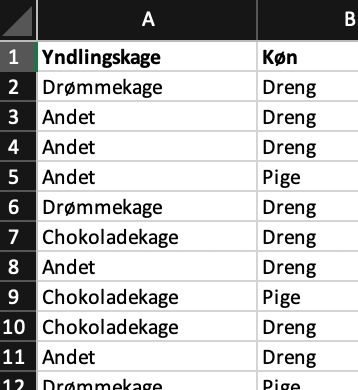
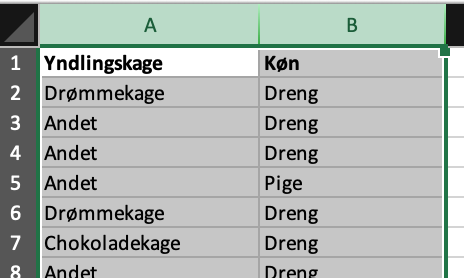
Normal tager vi udgangspunkt i data som er i rå form. Det er typisk et Excel-ark med en masse rækker. Her er et udsnit af data for uafhængighedstesten med kage:

(image)

Typisk har vi mange hundrede af observationer, så det er ikke praktisk at tælle dem op en ad gangen. I stedet får vi Excel til at lave tælle op for os. Vi siger at vi pivotere data og tabellen der fremkommer kaldes en pivottabel.

I det følgende vil vi tage udgangspunkt i filen kage.xlsx.

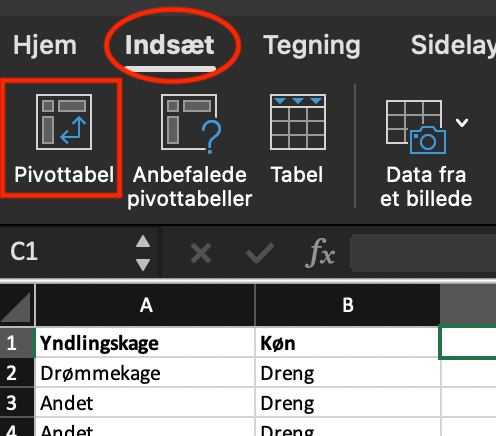
Først markerer vi alle data inkl. overskrifterne:

(image)

Så trykker vi ”Indsæt”, ”Tabeller” og så ”Pivottabel”:

(image)

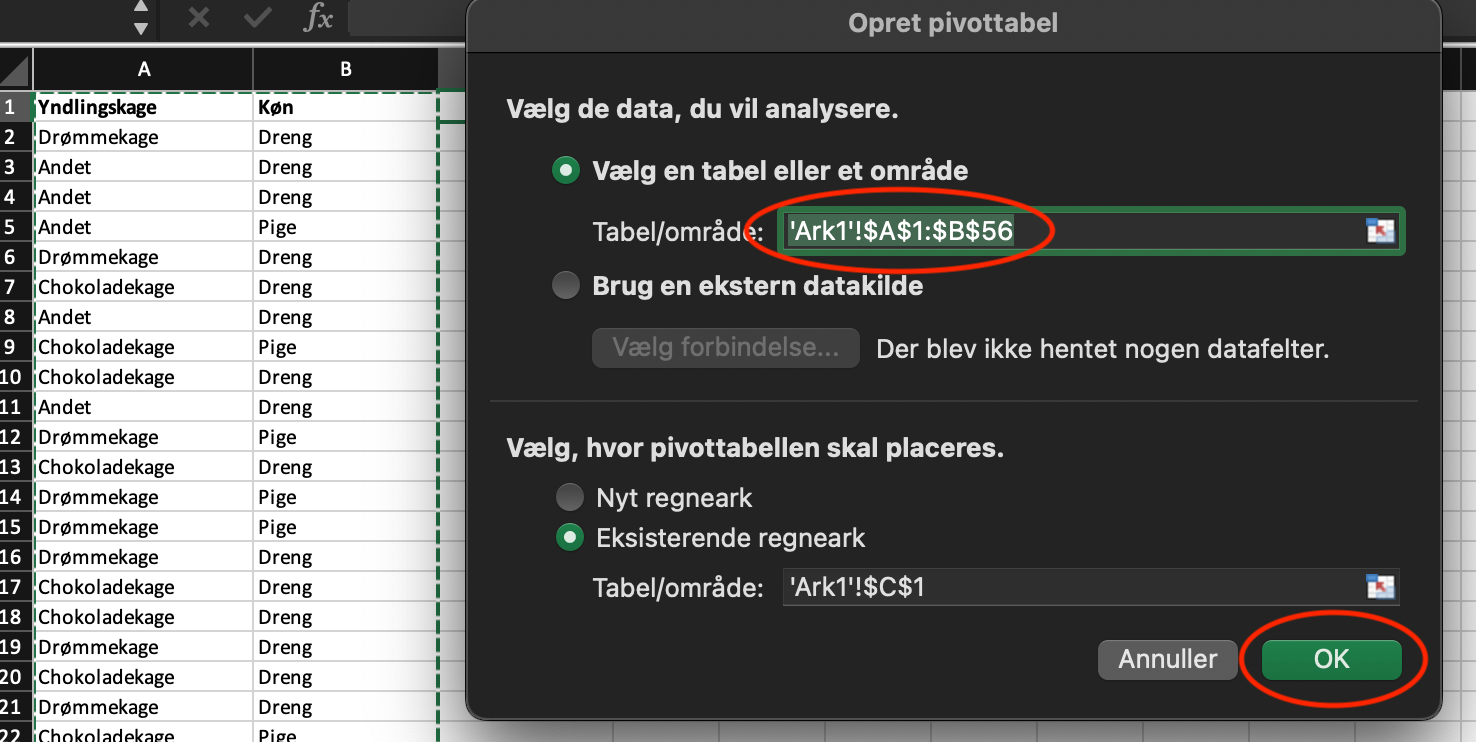
Her trykker vi OK:

(image)

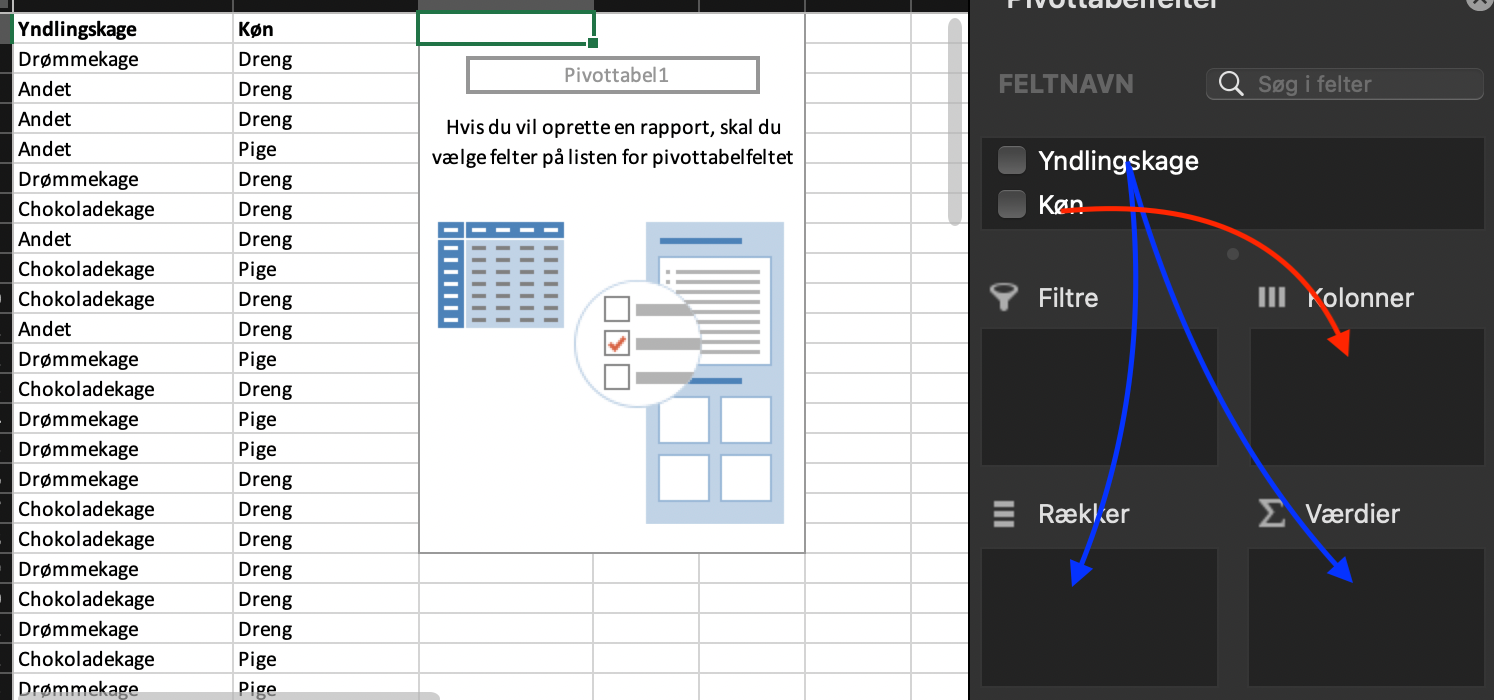
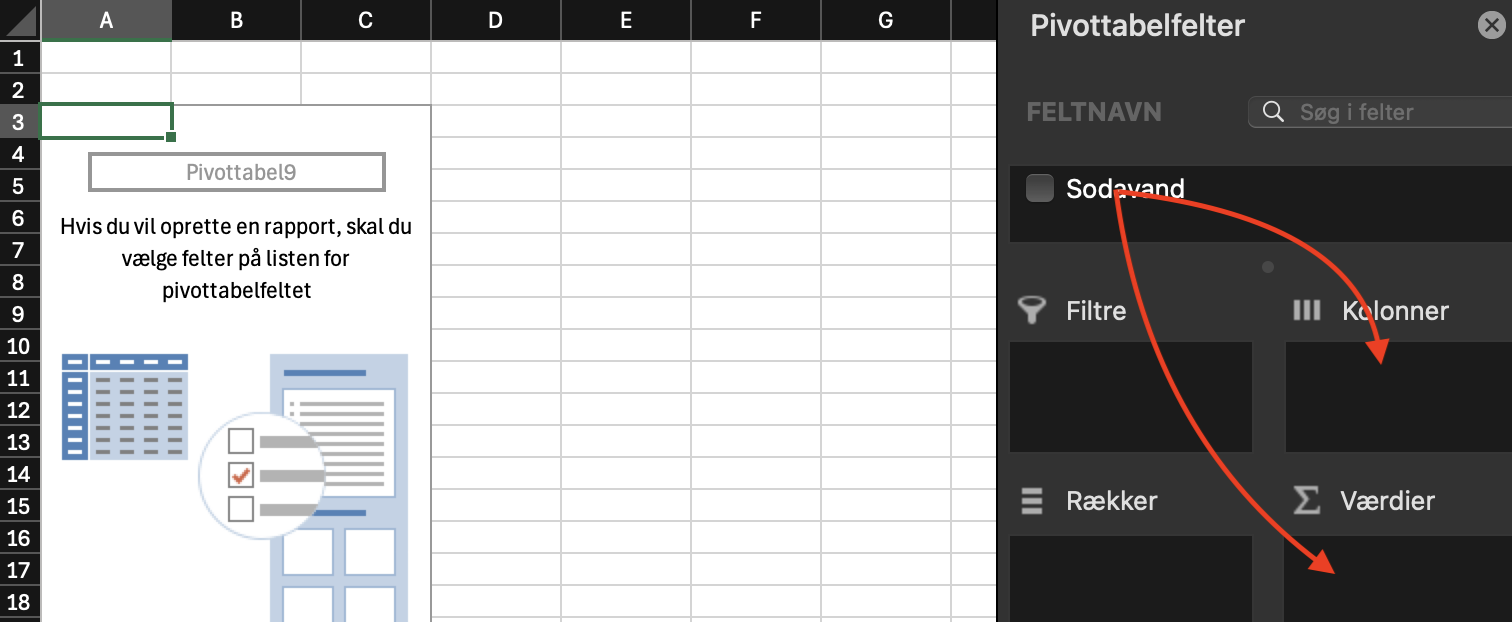
Så er det tid til drag and drop:

(image)

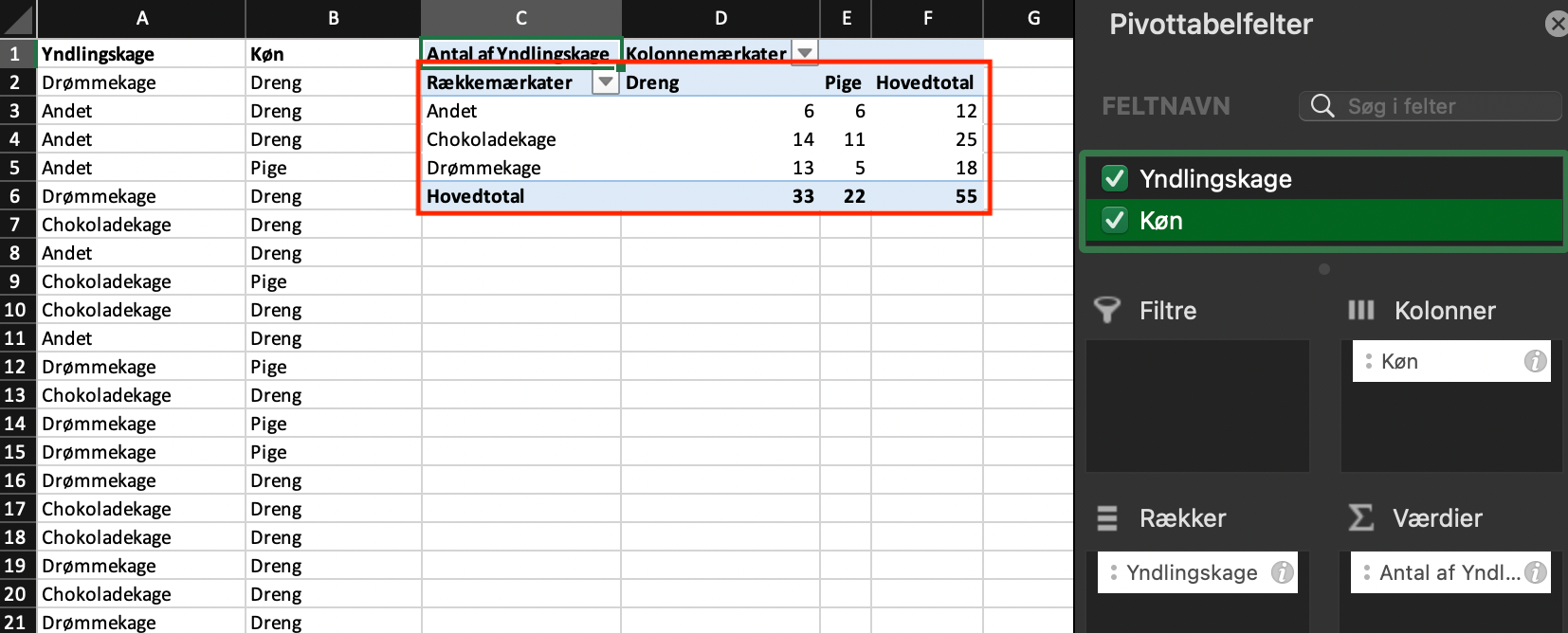
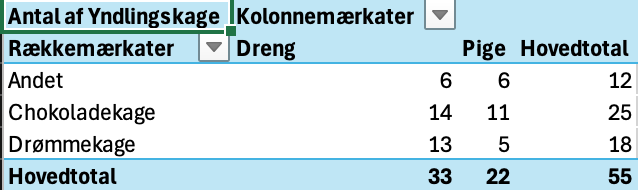
Og vi har vores tabel:

(image)

Pivottabeller for GOF-test

Vi kan også pivotere data for en GOF-test. Det gør vi på tilsvare måde. Kun drag and drop delen er lidt anderledes:

(image)

Øvelse 16.4.1

Download data for yndlingskager og sodavandsefterspørgsel:

kage.xlsx
sodavand.xlsx

  • a) Lav en pivottabel for kage-data (hvis du ikke allerede har gjort det)

  • b) Lav en pivottabel for sodavands-data

Løsning 16.4.1

  • a)
    (image)

  • b)
    (image)

Goodness of fit i GeoGebra

For at lave et GOF-test i GeoGebra, skal vi bruge observerede og forventede værdier. Lad os vende tilbage til sodavandseksemplet, hvor havde de observerede værdier:

.
Coca Cola Faxe Kondi Fanta
21 12 17

og de forventede:

.
Coca Cola Faxe Kondi Fanta
\(25\) \(15\) \(10\)

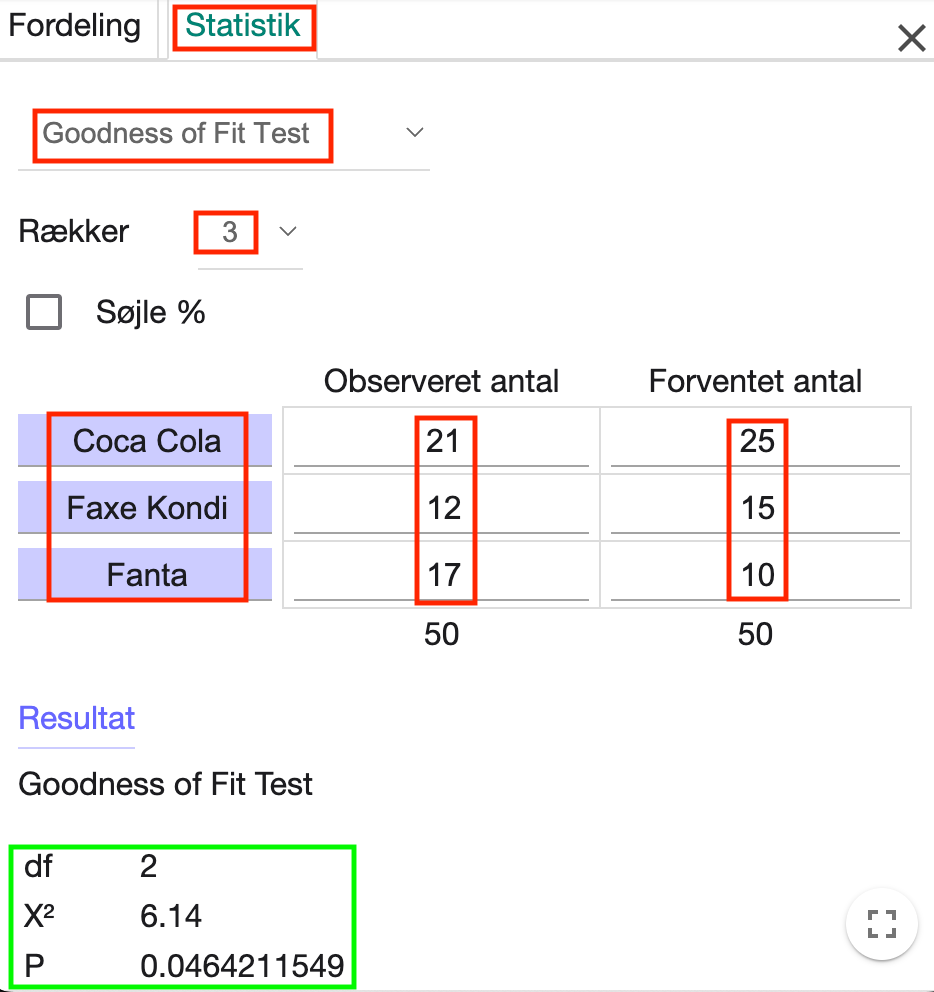
Vi åbner sandsynlighedslommeregneren i GeoGebra, vælger ”Statistik”, ”Goodness of Fit Test” og indtaster observerede og forventede værdier som vist her:

(image)

Vi ser i screenshottet at GeoGebra har bestemt, at der er \(2\) frihedsgrader, at teststørrelsen (som GeoGebra kalder \(X^2\)) er \(6{,}141\) og at p-værdien er \(0{,}046\). Vi kan også se på de totale værdier (\(50\) og \(50\)), at vi har regnet de forventede værdier rigtigt og tastet dem rigtigt ind.

Uafhængighedstest i GeoGebra

Med udgangspunkt i kagetesten har vi pivottabellen:

.
Dreng Pige Total
Drømmekage
\(13\) \(5\) \(18\)
Chokoladekage
\(14\) \(11\) \(25\)
Andet
\(6\) \(6\) \(12\)
Total
\(33\) \(22\) \(\textbf {55}\)

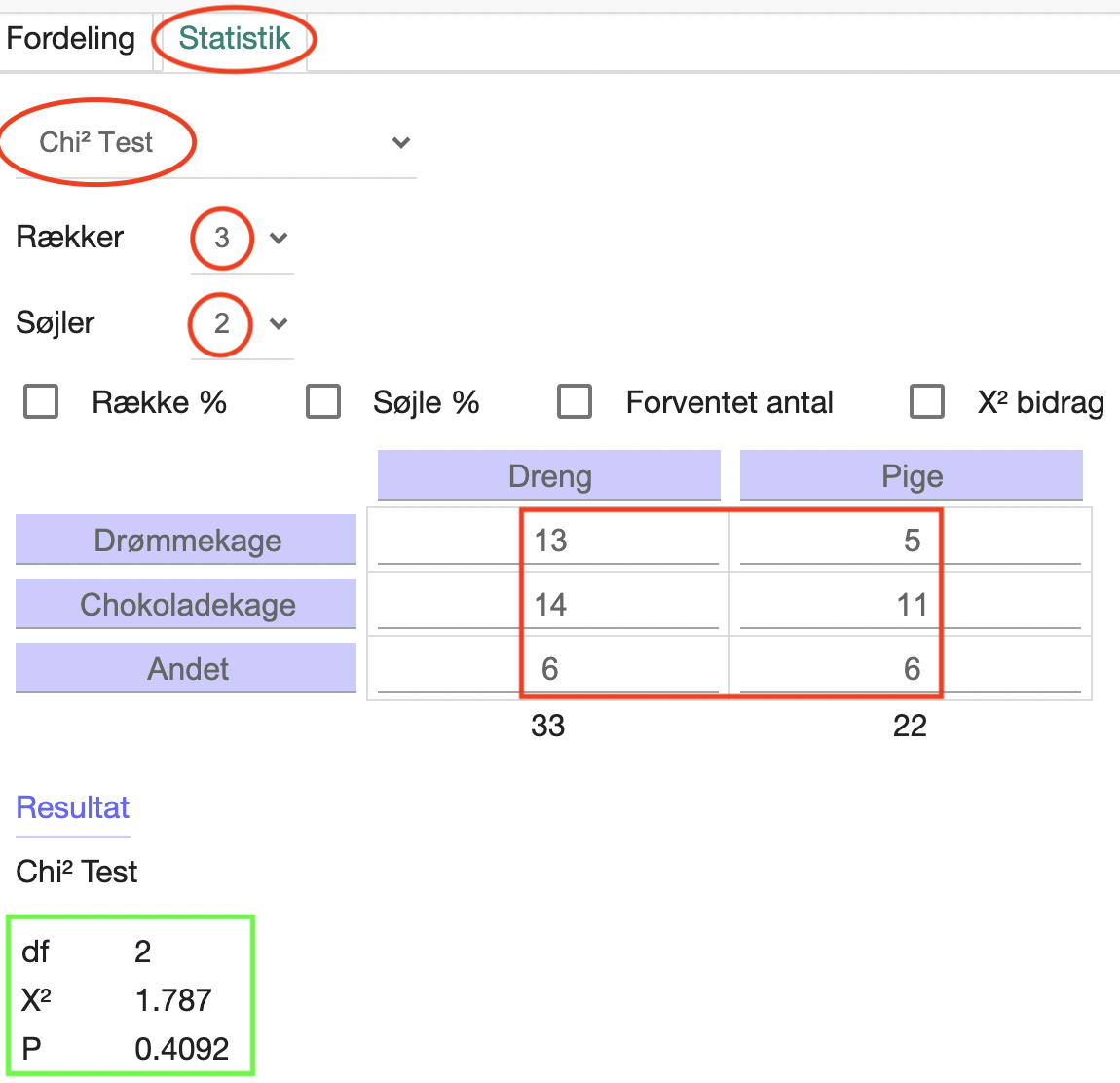
Vi åbner sandsynlighedslommeregneren i GeoGebra, vælger statistik, vælger ”Chi\(^2\)-Test” og indtaster de observerede værdier:

(image)

Vi ser (markeret med grønt), at der er \(2\) frihedsgrader, \(Q=1{,}79\) og \(p=0{,}41\) Vi holder lige øje med de totaler værdier (her altså \(33\) og \(22\)), så vi kan se, at vi har tastet rigtigt.

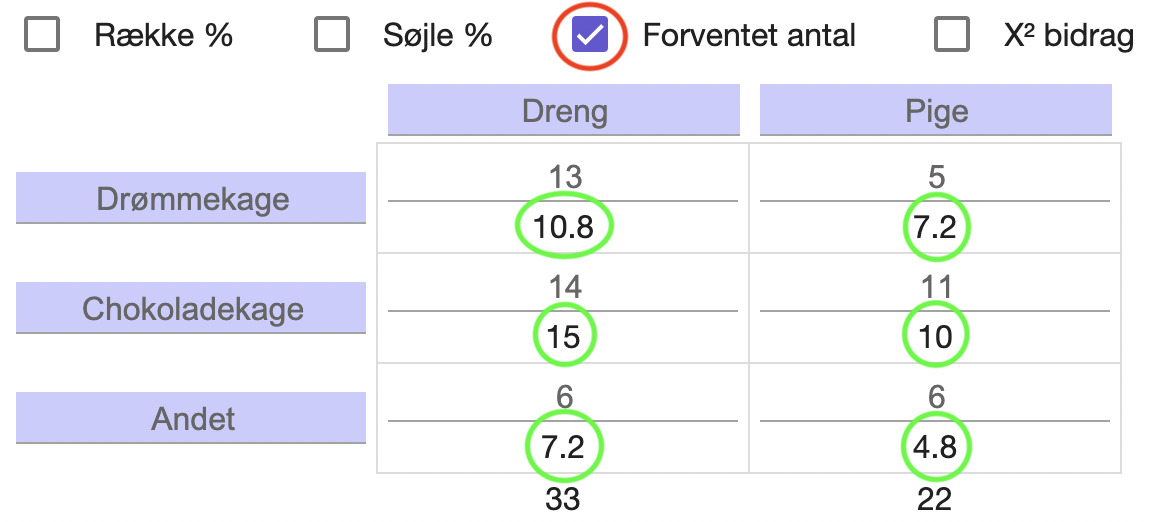
Vi kan også finde de forventede værdier:

(image)

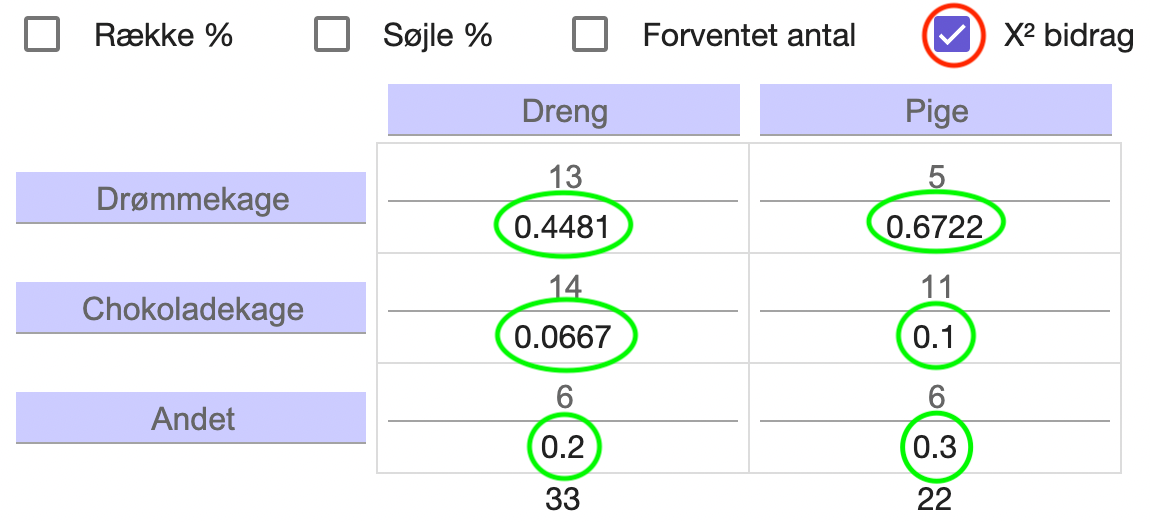
…og bidragene til \(\chi ^2\)-teststørrelsen:

(image)

Øvelse 16.4.2

Vi vender tilbage til øvelse 16.3.9 med produktion af 4-siddet terninger. I øvelsen var terningen kastet 80 gange og vi kunne ikke konstatere, at der var noget galt med terningen. Nu prøver vi igen, men denne gang kaster du den 2000 gange og skriver resultaterne ned i dette Excelark.

  • a) Lav en pivottabel med de observerede data.

  • b) Bestem de forventede værdier. Nulhypotesen er stadig at terningen er fair.

  • c) Bestem p-værdien i GeoGebra ved brug af ”Goodness of Fit Test"i sandsynlighedslommeregneren i GeoGebra.

  • d) Hvad bliver konklusionen denne gang?

Løsning 16.4.2

  • a)
    (image)

  • b)

    .
    1’ere 2’ere 3’ere 4’ere
    \(500\) \(500\) \(500\) \(500\)
  • c) \(p=15{,}6\%\)

  • d) Vi fastholder, at terningen er fair. Denne gang er vi mere sikre, fordi du har slået flere gange. Og så igen... hvad nu, hvis nu terningen kun var meget lidt skæv? Lad os sige at der var \(25{,}1\%\) sandsynlighed for at slå \(4\), så ville testen nok ikke kunne afsløre det. Selv med 2000 kast. Så det eneste vi rigtigt kan sige, er at vi ikke har belæg for at sige at terningen er skæv.

Øvelse 16.4.3

Disclaimer: Følgende er en tænkt situation.

En ridelærer havde lagt mærke til, at der var nogle hestenavne var særligt populære i Danmark. For hopperne var det Beauty, Freja, Lady og Musse. Ridelæreren havde en mistanke om, at alder måske kunne sige noget om, hvilke navne man bedst kunne lide. For at undersøge dette lavede hun en undersøgelse, hvor hun spurgte rideskolens medlemmer, hvilke af de 4 navne de bedst kunne lide.

Du skal nu vha. en \(\chi ^2\)-test undersøge om der er nogen sammenhæng mellem alder (junior, ungdom og senior) og yndlingsnavn. Brug \(\alpha =5\%\) og regn det hele i Excel og GeoGebra.

Data kan ses her her

  • a) Opstil hypoteser

  • b) Lav en pivottabel

  • c) Bestem de forventede værdier

  • d) Bestem bidragene til teststørrelsen.

  • e) Bestem antallet af frihedsgrader, teststørrelsen og \(p\)-værdien.

  • f) Afgør om vi skal forkaste \(H_0\).

  • g) Afgør om der er sammenhæng mellem holding til navn og alderskategori.

  • h) Forklar mere om sammenhængen mellem holdning til navn og alderskategori. Tag udgangspunkt i bidragene til \(\chi ^2\)-teststørrelsen og ud fra dem sammenlign de observerede og de forventede værdier.

Løsning 16.4.3

  • a) \(H_0\): Der er uafhængighed mellem alderskategori og navn.
    \(H_1\): Der er ikke uafhængighed mellem alderskategori og navn.

  • b)

    .
    Junior Senior Ungdom Total
    Beauty
    \(11\) \(19\) \(16\) \(46\)
    Freja
    \(19\) \(11\) \(22\) \(52\)
    Lady
    \(17\) \(10\) \(14\) \(41\)
    Musse
    \(36\) \(12\) \(12\) \(60\)
    Total
    \(83\) \(52\) \(64\) \(\textbf {199}\)
  • c)

    .
    Junior Senior Ungdom
    Beauty
    \(19{,}19\) \(12{,}02\) \(14{,}79\)
    Freja
    \(21{,}69\) \(13{,}59\) \(16{,}72\)
    Lady
    \(17{,}10\) \(10{,}71\) \(13{,}19\)
    Musse
    \(25{,}03\) \(15{,}68\) \(19{,}30\)
  • d)

    .
    Junior Senior Ungdom
    Beauty
    \(3{,}49\) \(4{,}05\) \(0{,}10\)
    Freja
    \(0{,}33\) \(0{,}49\) \(1{,}67\)
    Lady
    \(0{,}00\) \(0{,}05\) \(0{,}05\)
    Musse
    \(4{,}81\) \(0{,}86\) \(2{,}76\)
  • e) \(f=6\), \(Q=18{,}67\), og \(p=0{,}48\%\)

  • f) Jepper, da \(p<5\%\)

  • g) Det er der. Vi forkastede jo \(H_0\) og accepterede \(H_1\).

  • h) Der var især holdningsforskelle til navnene Beauty og Musse. Juniorgruppen kunne ikke lide navnet Beauty, mens seniorerne var vilde med det. Musse var til gengæld mægtig populært blandt juniorerne.

Ekstra

Er man god til Excel kan man lave \(\chi ^2\)-test hurtigt uden at indtaste i GeoGebra. Jeg vil vise metoden med udgangspunkt i uafhængighedsten med kage, men metoden virker også på GOF-test.

Start med at copy-paste din pivotabel to gange og slet indmaden i den ene:

(image)

Nu bruger du formlen for forventede værdier til at regne de forventede værdier. Husk at bruge dollartegn, så du kan ”trække” cellen.

(image)

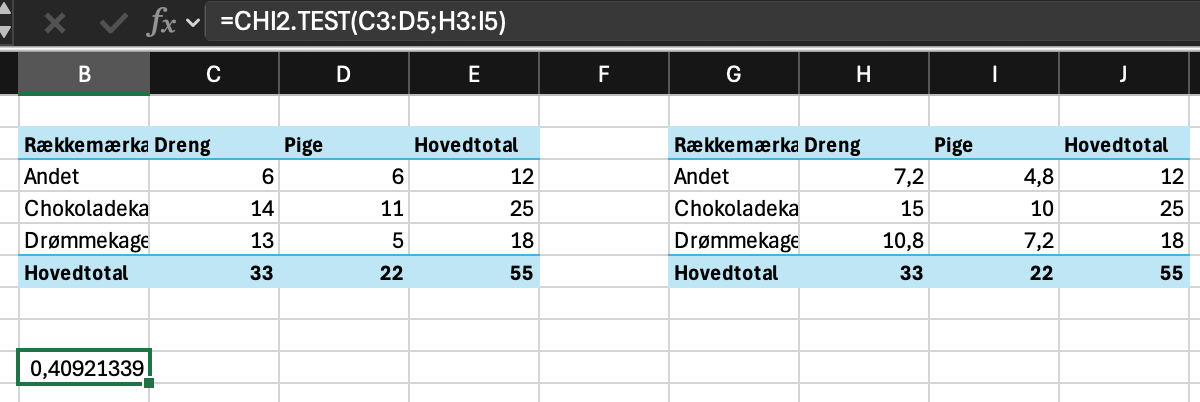
Nu kan du regne p-værdien med kommandoen CHI2.TEST. Du udfylder kommandoen ved først at markere de observerede værdier og så de forventede.

(image)

Vi ser at \(p=41\%\).

Havde det været en GOF-test, skulle vi selvfølgelig have regnet de forventede værdier med den metode vi lærte i GOF-afsnittet.
Øvelse 16.4.4

Download data for sodavandstest og kagetest:

sodavand.xlsx
kage.xlsx

Vi husker at den forventede fordeling for sodavandstesten var:

.
Coca Cola Faxe Kondi Fanta
\(50\%\) \(30\%\) \(20\%\)
  • a) Bestem p-værdien for sodavandstesten uden at bruge GeoGebra

  • b) Bestem p-værdien for kagetesten uden at bruge GeoGebra

Løsning 16.4.4

  • a) \(p=4{,}6\%\)

  • b) \(p=41\%\)